Showing posts with label Muslim. Show all posts

Sunday, 3 July 2011

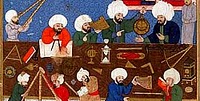
1001 Inventions: Muslim contributions to Civilisation


Visiting the Muslim Heritage Exhibition at the London Science Museum, I couldn't help wondering how ancient Arab scholars would view Muslims in the contemporary world.

Having said this, the discoveries and inventions of Arabs, as far back as the 7th century, remain largely unknown to the world at large. This is unfortunate since ancient Muslim genius is credited with paving the way for many important objects we use in everyday life. How about the toothbrush, for a start?

In 9th century Baghdad, the Beit al Hisma (House of Wisdom) created by the fifth Abbasid Caliph, Hārūn al-Rashīd, attracted the cream of Muslim intellect becoming a centre of learning and research without equal.

Working in 'The House,' Abū Yūsuf Yaqūb ibn Isāq al-Kindi, (considered the Father of Arab philosophy) translated works by Aristotle, as well as writing over 300 treatises, not only on philosophy, but mathematics, astronomy, meteorology and medicine.

Observatories were established; the oldest surviving astrolabe in the world was made in Baghdad, and the calculations of the 9th century mathematician Muhammad ibn Mūsā al-Khwārizmī, laid the foundation for future research into the development of the micro-chip.

The Abbasid caliphs themselves took a keen interest in science and the arts. Books acquired from libraries in Europe and the Middle East, were brought overland by camel for scholars to translate from the Latin, Greek, Persian, even Sanskrit texts.

Some of the many fascinating exhibits include surgical instruments, little different to those in use today; a copy of a map of the known world, conceived by the 12th century Andalusian cartographer al-Idrisi, and a model of the junk used by the Chinese Muslim explorer Zeng He,` a contemporary of Columbus, who visited 37 countries on his voyages of discovery.

Water wheels and windmills are rooted in ancient Muslim civilisations: clocks, cameras and conservatories were all conceived by Arabs. One Abbas ibn Firnas, a Berber living in 9th century Cordoba, was the first man to take flight using a pair of feathered wings.

These and other inventions can be seen in this unique display marred only by noisy and unruly visiting school groups.

Science Museum: London.


c.Christine Osborne.

Friday, 21 August 2009

RAMADAN: THE GIFT OF HUNGER


Islam is not alone in advocating strict disciplines at significant times of the year.

Devout Christians do not consume red meat during Lent, Hindus eat only once a day during Shravan Navratas, Jews observe many taboos on Yom Kippur, but the sawm (fast) is particularly difficult for Muslims, since not a crumb of food, nor a drop of water, can pass their lips during the daylight hours of the ninth month of the Islamic calendar. Smoking and intimacy, between dawn and dusk, are also forbidden during Ramadan which lasts 29-30 days until the sighting of the new moon in Mecca.

The Islamic calendar is eleven days shorter than the civil one which means that Ramadan rotates backwards every year. It is hard enough, but summer temperatures in Arab countries push people to their limits. And in northern Europe, where the mid-summer sun does not set until after 21.00, Muslims must abstain for a punishing 15-16 hours.

Fasting is not obligatory for children, the elderly, pregnant women, those of unsound mind and travellers going more than 50 miles a day. However they are not wholly excused, and instead must offer kafarah requiring they feed a poor person, for each day missed.

Muslims fast not merely for atonement, but in an endeavour to become closer to God through self discipline. Fasting teaches devotion, patience, fortitude and understanding. A painful stomach and a dry mouth show how the poor suffer on a daily basis.

Fasting induces a lightness of being that is spiritual, as well as physical. Many people will perform an extra twenty rakkas (bendings) during prayers. Others spend the long hours in a mosque making complete readings of the Qur`an.

Ramadan is equally a social occasion bringing Muslims together in the knowledge that all are suffering irrespective of class. A feeling of goodwill prevails. People give generously, women prepare special dishes for iftar (the bear-fast) when food is also cooked for the less well off.

A typical day of Ramadan begins when the family rises to eat before the fast begins at dawn.
In Muslim countries many businesses close as people spend the time listening to Qur`anic recitals, reading and sleeping, until sunset approaches when they emerge to walk off the final minutes of the sawm.

Streets are crowded from Dubai to Djakarta until minutes before sunset, roads empty as everyone heads back home. In Doha, the break-fast is announced by firing a cannon: in Dacca, a water-seller smashes a coconut to signal he is open for a drink.

People eat only a little at first, starting with dates and soup. The main meal, taken later with family members and close friends, is an occasion when food is enjoyed all the more, for having gone so long without.

Festivities last late into the night. Ramadan lamps twinkle, foodstalls do a brisk trade in snacks and softdrinks, children run from house to house singing traditional ditties, parks are packed and roads are jammed with cars sounding their horns, but next morning when the fast begins again, you can hear a pin drop.

c.Christine Osborne
Image: Girl reading the Holy Qu`ran
Image: Poor workers enjoy a free iftar meal in Dubai
Source: www.worldreligions.co.uk


Tuesday, 4 August 2009

CHINA BULLIES AUSSIE FILM FESTIVAL


If you don`t like the content of a film festival, you attack its website. At least that`s what the Chinese have done to the Melbourne Film Festival, over its decision to screen a 55 minute documentary on Rebiya Kadeer, the leading campaigner for Uighur rights.

Following the July clashes between ethnic Uighurs and Han Chinese (many forcibly settled in the Xinjiang in north-west China) Beijing has `pointed the bone`. And not only was the festival website hacked into, Chinese film-makers withdrew five of their films in a further exercise designed to spoil the event.

As head of the World Uighur Congress, Ms Kadeer is the champion of the Uighurs, a Muslim peoples of some 11 millions, scattered throughout central Asia, who make up 50% population in Xinjiang.

The Chinese label the Uighur nationalists as "terrorists" and following 9/11, they have manipulated global support for a self-declared "war on terror". Human rights groups have responded by accusing Beijing of using this as a pretext to repress Uighur culture and religion.

"Last time during the Tibet riots, [the Chinese government] blamed the Dalai Lama, and now with the Xinjiang riot, they are blaming me," Ms Kadeer told the BBC of the July riots.

As Ms.Kadeer continues her global travels, so the Chinese continue their protests, most recently to Japan.

Meanwhile the fate of thousands of Uighurs imprisoned after the riots remains unknown.


c.Christine Osborne
Image: Uighur barber`s in Xinjiang
Source: L.Mitchell www.copix.co.uk


Wednesday, 29 July 2009

SUDANESE WOMEN WHIPPED FOR WEARING TROUSERS


In 1993, I was invited to a WTO conference in Bali, but was refused admission at the door because I was wearing trousers. Not just any old pair of trousers, but a fashionable trouser suit. As a result I did not attend at all, because I had brought no dresses on the long flight from London.

Now I`m appalled to learn that the well known Sudanese journalist Lubna Ahmed al-Hussein is to be flogged for wearing trousers in a restaurant in Khartoum. And that women whipped earlier this month included some from the animist and Christian south where the Muslim north's sharia law does not apply.

Sudan is not high on most lists as a holiday destination, but potential women visitors should take heed. Remember, too, the British teacher Gillian Gibbons, arrested in 2007 for calling a toy bear Muhammad.

Is it any wonder that regimes such as that of dictator Oman al-Bashir give Islam a bad name?

His own punishment should be to be brought forcibly to London to see the shortest of shorts being worn this summer. Perhaps he would suffer a heart attack when the world would have one criminal less.

More power to your arm Ms.al-Hussain. I shall watch your trial with interest and wish you all the best.

c.Christine Osborne: former editor Two Niles/Sudan Airways flight magazine.
Image: Scene in Omdurman, Sudan
Source: www.copix.co.uk


Wednesday, 15 July 2009

THE MAN FROM SUDAN


I came home on the bus this morning with a man from the Sudan.

I had seen him many times, herding long-horned cattle, or playing an oud with long fingers that now clutched a cheap plastic briefcase. And clearly he did not know where to go.

`Can I help?` I said, touching his elbow gently.

I noticed a trace of orange henna at his temples, as he turned towards me. Many Muslims dye their beard with henna when they have performed the hajj. His beard has been shaved off, but the trace of henna and the zebiba (prayer mark) on his forehead, tells me he is a good Muslim. A good Muslim with one wonky eye.

`Clapham Common,` he said in an almost panicky voice, bending down, all six feet six of him, to look anxiously out of the window as we crossed Vauxhall bridge.

`Yallah,` I said getting off at the inter-change. But he was far too concerned about Clapham Common to realise that a strange `English` woman had uttered a word of Arabic in the heart of Vauxhall.

`Bus 88 Clapham Common, over there!` I tell him.

`Thanks you much!` he said, evidently knowing the way.

I watched him hurrying along the road in his new brown leather shoes until he disappeared on a traffic crossing and was out of sight.

It could have been me, a thousand times over, struggling to find my way around Sana`a, Salalah or Khartoum.

c.Christine Osborne
Image: Prayer by the Blue Nile, Sudan
Source: Liam White: www.worldreligions.co.uk

Blog Archive